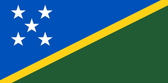
Solomon Islands
The Solomon Islands is a scattered archipelago of six main islands and 400 smaller islands situated some 1,800 kilometres north-east of Australia. Its closest neighbors are Papua New Guinea and Vanuatu. The population of the Islands (mainly Melanesian) is 450,000 and is growing at a rate of over 3% per annum – the highest population growth rate in the region. Half of the population is estimated to be under the age of 18. The islands’ per capita income, never high, has almost halved over the last five years to below $500.
Self-government was achieved in 1976 and independence two years later. Ethnic tension, mostly over land rights and jobs, between the indigenous people of Guadalcanal and settlers from Malaita province, has been simmering for over 40 years, but escalated in 2000. Malaitans migrated to Guadalcanal in large numbers after WWII looking for work when the capital was moved to Honiara on Guadalcanal to take advantage of a large airstrip started by the Japanese and completed by US forces. Malaitans adapted to Western influence and education and gained key positions in the public sector and government. This provoked resentment among the indigenous people of Guadalcanal, who responded by driving many Malaitans from their homes. Early in 2000, Malaitans, frustrated at perceived government inaction in meeting their demands for compensation for the properties they left behind on Guadalcanal, raided the police armory at Auki, Malaita and seized all its weapons. These were gradually transferred over to Honiara and on June 5 2000 a group seized the police armory in Honiara, in collaboration with sympathetic members of the local police, and held Prime Minister Ulufa'alu hostage. On 14 June 2000 Ulufa'alu resigned “for his own safety.”
Following some protracted negotiations between the new government and the two militant groups (IFM and MEF) an Australia-brokered ceasefire agreement was finally signed on August 5, 2000. A peace agreement was signed in October 2000. Inter-ethnic fighting ceased and some 2,000 weapons were subsequently handed in to the International Peace Monitoring Team (IPMT). Many high-powered weapons remained in the hands of former militants, and a climate of fear continued with violent criminality and police corruption. The economic situation continued to deteriorate. In early 2003 the government was subjected to armed threat by a small number of police to extract millions of dollars of public funds claimed as compensation. By this stage government services were virtually non-existent due to the lack of funds – schools and clinics closed in many rural areas. The Solomon Islands became a failed state.
The year 2003 also marked the beginnings of social and economic recovery, however. A new Royal Solomon Islands Police (RSIP) Commissioner, jointly funded by the UK and the EU, arrived from the UK. In July, a Regional Assistance Mission to the Solomon Islands (RAMSI) arrived, an initiative led by Australia and New Zealand, with personnel support from other South Pacific countries. The combined military/police/civilian expert task force initially included 2,300 armed troops, helicopters, and five naval vessels.
RAMSI's first priority was restoration of law and order. It was initially achieved with remarkable success. Criminals were arrested and weapons were handed in without any loss of life. 300 Australian and regional policemen strengthened the RSIP and public confidence in the police started to return. The military component of RAMSI was scaled down at the end of 2003. Considerable effort is now being directed at good governance and restoring government services. In November 2003 a national economic recovery plan and budget was approved by Parliament and presented to donors. The main international donors, i.e. World Bank and Asian Development Bank, who had suspended activities due to the law and order problems, committed to re-engage. The EU also announced the release of a package of funds which had been on hold since 2000.
In April 2006, widespread rioting and looting took place following the election of a new Prime Minister, Rini Snyder. Opponents said he favored local Chinese businessmen. Nearly all of China Town in Honiara was destroyed along with many other buildings, including a major hotel (the Pacific Casino). After a week in office, Snyder stepped down and a new Prime Minister, Mannaseh Sogavare, was subsequently elected to popular acclaim. Sogavare leads the Social Credit Party and served as premier between 2000-2001. He campaigned on promises to tackle widespread corruption.
The current economic outlook is bleak. The violence associated with the ethnic conflict caused extensive damage to personal property, transport infrastructure, schools, water supply and sanitation systems, government buildings, and the health sector. Government revenue has fallen while government payroll expenditure rose dramatically during the same time, primarily as a result of massive recruitment of "Special Constables.” The Islands are mainly supported by a subsistence economy, and with the ethnic unrest and lawlessness there has been little inward or outward investment. A number of high profile foreign investors withdrew during the unrest resulting in the closure of the Gold Ridge goldmine and the Solomon Islands Plantations Ltd (palm oil) with significant job losses. The closure of the gold mine at Gold Ridge has been particularly damaging, and it is uncertain, even with the improved law and order situation and a new management team in place, how soon the mine can re-open. The earliest prediction of this is the end of 2007. The economy is heavily reliant on development aid and logging income, both of which are likely to decline sharply in the medium term. An alternative driver of the economy has to be found, such as an expanded tourist industry.
The Solomon Islands has close relations with Australia and New Zealand (although 2006 saw a significant diplomatic row with Australia –see “Recent Incidents” below). Australia and New Zealand both played an important role in RAMSI, and, before that, in brokering the peace agreement. The Islands also have close relations with Papua New Guinea, their fellow Melanesians. The Solomon Islands is a member of the UN and the Commonwealth. Regionally, it is a member of the Pacific Islands Forum and the Pacific Community.
Political tensions in the Solomon Islands are high. Although there has been no repeat of the wide-scale civil unrest of April 2006, the security situation in and around the capital, Honiara, remains uncertain and could deteriorate at short notice.
Land ownership in the Solomon Islands is an important and sensitive issue. Walking and trekking off the beaten track, therefore, may require payment of a “kastom” fee to the landowner.
Avoid ferry services, as they are crowded and safety regulations are not strictly applied. If you must take these services, bring your own lifejacket. Journeys to small and/or remote islands are usually in small-motorized “canoes.”
Salt-water crocodiles are native to parts of the Solomon Islands, and there have been sightings on beaches.
When driving, note that Solomon Islanders chew betel nut and frequently open vehicle doors, including on the driver's side, when travelling at speed, in order to spit out the juice onto the road. Many roads are in poor condition.
Dress codes, particularly for women, are modest and you will gain respect by dressing appropriately.
In certain areas there are “taboo” sites only visited by men.
Solomon Islanders do not object to being photographed but you should ask permission first.
The tropical cyclone season in the Solomon Islands normally runs from November to May.