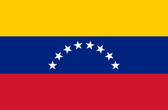
Venezuela flag Venezuela
Venezuela was one of the three countries that emerged from the collapse of Gran Colombia in 1830 (the others being Colombia and Ecuador). For most of the first half of the 20th century, Venezuela was ruled by generally benevolent military strongmen, who promoted the oil industry and allowed for some social reforms. Democratically elected governments held sway from 1959 to the Chávez era. President Hugo Chávez first became known in 1992, when - as an army paratrooper - he led a military coup attempt that succeeded everywhere in the country except in Caracas, the capital. He was arrested but made a famous televised speech in which he told Venezuelans his struggle had been blocked - "for now." He was imprisoned. In 1994, then-President Andres Perez was impeached by Congress on corruption charges and replaced by President Rafael Caldera, who freed Chávez and fellow coup leaders. Chávez swept to power in 1998 with overwhelming support from Venezuela's poor. Chávez charmed many Venezuelans with his gregariousness and refreshingly frank talk. But he also insisted on wearing his army uniform and red beret - projecting an image that reminded many of Latin America's former military dictators. He quickly consolidated his power, extending his own four-year term to 2006 and revamping the constitution, Congress and the courts in a series of election and referendum victories. However, the moves caused class division and irritated foreign governments. Chávez assigned the military duties that had traditionally belonged to civilians, including social works, building roads and bridges and distributing food. He was criticized for rejecting U.S. help during disastrous 1999 flooding in Vargas State. He promised a new era of equality but his anti-American rhetoric, military image and cozy relationships with international pariahs like Saddam Hussein and Fidel Castro often seemed a throwback to Latin America's darker days. Many of the poor still see him as a hero. But other powerful allies - labor groups and the military –became disillusioned with him. He alienated Washington with visits to Libya and Iraq, his close friendship with Cuba's Fidel Castro, and his "neutral" stand in Colombia's civil war. He also angered the Bush administration by criticizing U.S. bombing in Afghanistan after the September 11 terrorist attacks. Dissent began to grow within the military. Commanders who had fought Cuban-backed guerrillas in the 1960s and 70s resented his friendship with Castro. They were angered by his ties with leftist Colombian guerrillas - including his denials that the rebels sometimes operated in Venezuelan territory. Officers objected to Chávez 's distancing of Venezuela from the United States, including a decision to suspend Venezuela's participation in regional military exercises. They were also troubled by reports that he was secretly arming neighborhood block committees known as "Bolivarian Circles," named after South American liberator Simon Bolivar. In the all-important oil industry, Chávez was a proponent of higher prices and better discipline among members of the Organization of Petroleum Exporting Countries. His effort to tighten control over the state oil monopoly was a serious misstep. When he tried to appoint his loyalists to run the company, Petroleos de Venezuela, managers revolted. Other labor groups, frustrated by $21 billion in back wages and pensions owed to workers, joined demonstrations that ended in resignation. Chávez was temporarily forced from power in April 2002 after mass protests resulting in the deaths of at least 12 anti-Chávez demonstrators by suspected pro-Chávez gunmen. Venezuelan military officers, blaming Chávez for the deaths, forced him to resign and ushered in a transition government led by a civilian businessman Pedro Carmona, the president of Venezuela's leading business association Fedecamaras. Chávez was placed in military custody to await possible trial and senior officers from all branches of the military -- Army, Navy, Air Force and National Guard -- announced the formation of a transition government led by Carmona. Chávez asked to leave the country for Cuba but was refused. Two days later, however, Carmona was forced to resign after popular unrest and an uprising by military units loyal to Chávez . Although Chávez called for national unity following his return to power, at least 80 military officers as well as Carmona were held in detention. Chávez blamed the coup attempt on a conspiracy, but refused to blame military personnel. Having survived a coup, protests, strikes and a referendum on his rule since coming to power in 1998, Chávez remains the subject of both adulation and loathing among his divided electorate. Radical reform, political unrest and deep divisions have characterized his term in office. His supporters - known as "chavistas" - and his detractors have staged street protests. He has pursued populist policies aimed at helping the poor. The programs include free health care, subsidised food and land reform. Under his leadership, the country has sought to strengthen its regional influence through diplomatic and economic overtures towards other South American and Caribbean nations. This has been seen, in part, as an effort to counter Washington's influence in the region. He was re-elected in December 2006 for another six-year term.
While there are no known threats to expatriates in or travelers to Venezuela, areas along the border with Colombia should be avoided in light of occasional spillover rebel activity. Current concerns include drug-related conflicts along the Colombian border, increasing internal drug consumption, overdependence on the petroleum industry with its price fluctuations, and irresponsible mining operations which are endangering the rain forest and indigenous peoples. Crime has also increased at an alarming rate in recent years. "Express kidnappings," in which victims are seized in an attempt to get quick cash in exchange for their release, are on the rise in Caracas. While not identified as specific targets of such "express kidnappings," foreigners may be viewed as more likely to have access to large sums of money. Therefore, travelers should be alert to their surroundings and take necessary precautions. Frequent labor or student unrest is another potential concern for travelers and residents. Cross-border violence occurs frequently in remote areas along the Colombian border in Zulia, Tachira, Apure and Amazonas states. Colombian guerrillas, who frequently operate on both sides of the border, were suspected in the kidnappings in the area in the past. Kidnapping, smuggling, and drug trafficking are common along the border between Venezuela and Colombia. Foreigners visiting certain areas along the border with Colombia may be subject to search and seizure. Sporadic political demonstrations occur in urban centers. These tend to focus primarily on or near university campuses or secondary schools, and sometimes turn violent. Most tourist destinations, however, remain unaffected. The number and intensity of demonstrations have fluctuated widely. Merida, a major tourist destination in the Andes, is the scene of frequent student demonstrations.