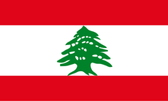
Lebanon flag Lebanon
Lebanon has made progress toward rebuilding its political institutions and regaining its national sovereignty since 1991 and the end of the devastating 16-year civil war. Under the Ta'if Accord - the blueprint for national reconciliation - the Lebanese have established a more equitable political system, particularly by giving Muslims a greater say in the political process while institutionalizing sectarian divisions in the government. Since the end of the war, the Lebanese have conducted several successful elections, most of the militias have been weakened or disbanded, and the Lebanese Armed Forces (LAF) have extended central government authority over about two-thirds of the country. Hizballah, the radical Shi'a party, retains its weapons. Foreign forces still occupy areas of Lebanon. Israel maintains troops in southern Lebanon and continues to support a proxy militia, the Army of South Lebanon (ASL), along a narrow stretch of territory contiguous to its border. Syria maintains about 25,000 troops in Lebanon based mainly in Beirut, North Lebanon, and the Bekaa Valley. Syria's troop deployment was legitimized by the Arab League during Lebanon's civil war and in the Ta'if Accord. Damascus justifies its continued military presence in Lebanon by citing the continued weakness of the LAF, Beirut's requests, and the failure of the Lebanese Government to implement all of the constitutional reforms in the Ta'if Accord.
Until the outbreak of Lebanon’s civil war in 1975 and subsequent Israeli and Syrian interventions and occupations, the nation boasted one of the most robust and promising economies in the Middle East. While without significant resources of its own, Lebanon rode the wave of the Middle East oil boom to become the financial and banking services center of the region with robust tourism and a rapidly growing industrial sector. Some would argue that the spark that ignited Lebanon’s civil war (1975-1990) occurred in Beirut on April 13, 1975, when suspected Palestinian gunmen killed four people during an attempt to assassinate Pierre Jumayyil, head of the Maronite Christian Phalange Party. For many observers, at the bottom of the conflict was the issue of confessionalism out of balance--of a minority, specifically the Maronites, refusing to share power and economic opportunity with the Muslim majority. Whether true or not, there is no doubt that the influx of armed Palestinian refugees into the country shifted the balance of power irrevocably. The civil war devastated Lebanon’s economic infrastructure and political institutions while dramatically altering the nations social fabric. Much of Lebanon’s economic and entrepreneurial leadership fled the country. The services sector collapsed or re-located overseas, and the industrial and agricultural infrastructure was devastated. The decade and a half of chaos also saw the emergence Islamic terror groups, regional warlords and Maronite Christian militia groups with vastly disparate agendas. With the re-establishment of a semblance political stability and centralized government control in 1990 and the withdrawal of Israel troops in 2000, Lebanon's economy has made significant gains; an $18 billion reconstruction program named Horizon 2002 was launched in 1993 by billionaire Prime Minister Rafiq al-Hariri. Lebanon's GDP grew by about eight percent in 1994, and in the period between 1992 and 1998, annual inflation dropped from 170 percent to six percent, while the foreign exchange reserves increased from $1.4 billion to close to $6 billion. The government tapped foreign exchange reserves and increased borrowing to finance these reconstruction programs. During a short-lived austerity program between 1998-2001, economic growth slowed, but since 2001, the government has aimed is to achieve modest real economic growth of 3 to 5 percent. Political Note In an effort to redress the inequities of the pre-1975 government, a formal system of power sharing among Lebanon's 18 officially recognized religious confessions to enfranchise all interests in civil society was established in 1990. The effective end result is a “troika” at the highest levels proscribed as the following: · The President must be a Maronite Christian, · The Prime Minister must be a Sunni Muslim, and; · The Speaker of Parliament must be a Shiite Muslim. The President is elected for a six-year term by the Parliament. The current President is Emile Lahoud (1998-Present). The next Presidential elections are due in November 2003. The Prime Minister, nominated by the President in consultation with the Speaker of Parliament, is subject to the Chamber's vote of confidence. The current Prime Minister is Rafiq al-Hariri (1992-1998, 2000-present) who was reaffirmed in April 2003. Lebanon’s 128 deputies (the Chamber), are elected by the voters for four-year terms, and are divided equally between Christians and Muslims The deputies choose the Speaker of Parliament. Nabih Birri (1993-Present)is the current Speaker. Parliamentary elections are due in August/September 2004. Assessment Lebanon is still emerging from the devastating 1975-1990 civil war and the government of Lebanon does not have effective control in certain areas of the country. Syria continues to maintain approximately 15,00-20,000 soldiers in Lebanon, located primarily in the Bekaa Valley, on strategic roadways and in around major cities. Forces loyal to the Islamic extremist group Hizballah control some areas of Southern Lebanon. Israeli forces withdrew from South Lebanon in 2000. While there have been relatively few terrorist attacks in Lebanon during recent years, the perpetrators of previous terrorist campaigns are still present in Lebanon and retain the ability to act. After the collapse of the South Lebanon Army (SLA) in May 2000, Israel withdrew its troops from southern Lebanon, more than six weeks before its stated deadline of July 2000. Armed fighters loyal to Hizballah subsequently occupied positions in South Lebanon. Despite this, Lebanon’s political outlook rests heavily on political relations within the state’s fractious elite and, in particular, their readiness and ability to co-operate to realize the economic reform program that Prime Minister Hariri has tried to implement. In the period immediately following Hariri’s re-appointment in October 2000 (following less than stellar 1998-2000 premiership of Salim al-Hoss), there were promising signs of an improvement in the political process, with Hariri winning of support from the other members of the troika (President Emile Lahoud and Parliamentary Speaker, Nabih Birri) for his reform agenda. With Harari reaffirmed as Prime Minister in April 2003, prospects for effective government remain high. Salim al-Hoss’ weak administration, during its tenure, had little drive or political authority. Tensions within the current troika, however, have never been fully resolved and simmering rivalry between Hariri and President Lahoud continue. Relations between the two forceful leaders have long been poor, and it was their rivalry that contributed to the end of Hariri's first period in office in 1998. The power struggle also embodies the clash between Hariri's elected government and the Syrian affiliated Lahoud, whose authority stems from his alleged readiness to execute Damascus’s wishes and his control of the military and security services. Terror Groups Lebanon is fighting a difficult battle to expunge its 1980’s image as the terror capital of the world. Once considered the “Paris” of the Middle East, the tourist industry is eager to change that image With the re-establishment of a central authority, the level and intensity of terrorist activities in Lebanon have diminished in the last decade. Nevertheless, the perpetrators of past terror campaigns remain in the country and retain the capability of launching attacks against Western, Lebanese or Israeli targets. While their ability to destabilize the country as a whole has diminished, they remain obstacles to foreign investment, tourism and other economic and political rebuilding efforts. Terrorist organizations that actively operate or maintain a presence in Lebanon currently include the following · Asbat al-Ansar (The Partisans' League) Asbat al-Anzar is a Lebanon-based, Sunni extremist group, composed primarily of Palestinians, which is associated with Usama Bin Ladin’s al-Qaida terror network. The group follows an extremist interpretation of Islam that justifies violence against civilian targets to achieve political ends. Some of those goals include overthrowing the Lebanese Government and thwarting perceived anti-Islamic influences in the country. Asbat al-Ansar has carried out several terrorist attacks in Lebanon since it first emerged in the early 1990s. The group carried out assassinations of Lebanese religious leaders and bombed several nightclubs, theaters, and liquor stores in the mid-1990s. The group raised its operational profile in 2000 with two dramatic attacks against Lebanese and international targets. The group was involved in clashes in northern Lebanon in late December 1999 and carried out a rocket-propelled grenade attack on the Russian Embassy in Beirut in January 2000. The group's primary base of operations is the ‘Ayn al-Hilwah Palestinian refugee camp near Sidon in southern Lebanon. · Hizballah (Party of God) Formed in 1982 as an umbrella group in response to the Israeli invasion of Lebanon, this Lebanon-based radical Shiite group takes its ideological inspiration from the Iranian revolution and the teachings of the Ayatollah Khomeini. The Majlis al-Shura, or Consultative Council is the group's highest governing body and is led by Secretary General Hassan Nasrallah. Hizballah formally advocates ultimate establishment of Islamic rule in Lebanon and liberating all occupied Arab lands, including Jerusalem. While Hizballah does not share the Syrian regime's secular orientation, the group has been a strong tactical ally in helping Syria advance its political objectives in the region. Known or suspected to have been involved in numerous anti-Western terrorist attacks, including the suicide truck bombings of the US Embassy in Beirut April 1983 and US Marine barracks in Beirut in October 1983 and the US Embassy annex in Beirut in September 1984. Elements of the group were responsible for the kidnapping and detention of Western and Israeli hostages in Lebanon. In fall 2000, it captured three Israeli soldiers in the Shabaa Farms and kidnapped an Israeli noncombatant whom it may have lured to Lebanon under false pretenses. In July 2003 the group threatened to resume kidnapping Israelis unless Israel opened negotiations for a prisoner exchange. Hizballah operates in the Bekaa Valley, Hermil, the southern suburbs of Beirut, and southern Lebanon. It has also established cells in Europe, Africa, South America, North America, and Asia. · HAMAS (Islamic Resistance Movement) Formed in late 1987 as an outgrowth of the Palestinian branch of the Muslim Brotherhood. Various HAMAS elements have used both political and violent means, including terrorism, to pursue the goal of establishing an Islamic Palestinian state in place of Israel. HAMAS maintains loose ties with other Palestinian groups and Islamic groups operating in Lebanon. Loosely structured, with some elements working clandestinely and others working openly through mosques and social service institutions to recruit members, raise money, organize activities, and distribute propaganda. HAMAS's strength is concentrated in the Gaza Strip and a few areas of the West Bank. Also has engaged in political activity, such as running candidates in West Bank Chamber of Commerce elections. HAMAS activists, especially those in the Izz el-Din al-Qassam Brigades, have conducted many attacks— including large-scale suicide bombings—against Israeli civilian and military targets. It is not known to have carried out any direct attacks in Lebanon. · Popular Front for the Liberation of Palestine (PFLP) The PFLP is a Marxist-Leninist group founded in 1967 by George Habash as a member of the PLO. The PFLP joined the Alliance of Palestinian Forces (APF) to oppose the Declaration of Principles signed in 1993 and suspended participation in the PLO. It broke away from the APF, along with the DFLP, in 1996 over ideological differences. The PFLP has conducted attacks against Israeli or moderate Arab targets and after a period in inactivity, stepped up operational activity in 2001, highlighted by the shooting death of Israeli Tourism Minster in October to retaliation for Israel's killing of PFLP leader in August. The PFLP maintains a strong presence in Lebanon’s Palestinian refugee camps and periodically clashes with its political rivals therein. · Popular Front for the Liberation of Palestine General Command (PFLP-GC) The PFLP-GC split from the PFLP in 1968, claiming it wanted to focus more on fighting and less on politics. Opposed to Arafat's PLO. Led by Ahmad Jabril, a former captain in the Syrian Army. Closely tied to both Syria and Iran. Carried out dozens of attacks in Europe and the Middle East during 1970s-80s. Known for cross-border terrorist attacks into Israel using unusual means, such as hot-air balloons and motorized hang gliders. Primary focus now on guerrilla operations in southern Lebanon, small-scale attacks in Israel, West Bank, and Gaza. The PFLP-GC maintains a strong presence in Lebanon’s Palestinian refugee camps and periodically clashes with its political rivals therein. · The Palestine Islamic Jihad (PIJ) The PIJ Originated among militant Palestinians in the Gaza Strip during the 1970s. PIJ-Shiqaqi faction, currently led by Ramadan Shallah in Damascus, is most active. PIJ activists have conducted many attacks including large-scale suicide bombings against Israeli civilian and military targets. The group increased its operational activity in 2001 during the Intifadah, claiming numerous attacks against Israeli interests. The group has not targeted US interests and continues to confine its attacks to Israelis inside Israel and the territories. The group maintains a small presence in Lebanon and is believed to have close links with the Hizballah group. · Al-Qaida (Qaidat al-Jihad) Usama Bin Ladin established the al-Qaida organization in the late 1980s to bring together Arabs who fought in Afghanistan against the Soviet Union. The current goal of al-Qaida is to establish a pan-Islamic Caliphate throughout the world by working with allied Islamic extremist groups to overthrow regimes it deems "non-Islamic" and expelling Westerners and non-Muslims from Muslim countries. On 11 September, 19 al-Qaida suicide attackers hijacked and crashed four US commercial jets into targets in the United States, Including the World Trade Center Towers leaving about 3,000 individuals dead or missing. The group is also believed behind a number of attacks worldwide against western and moderate Arab targets, including the 2003 attacks in Riyadh, Saudi Arabia. It is believed that al-Qaida operatives are active in Lebanon and that it maintains close ties with other terror organizations operating there. Major Security Concerns Despite the withdrawal of Israeli forces in May 2000 and the collapse of the Israeli supported South Lebanese Army (SLA), Hizballah remains active in the south along Israel’s border. The result has been periodic tit-for-tat cross-border exchanges that have kept the prospect of renewed Israeli incursions alive. Elsewhere, political infighting at Palestinian refugee camps has resulted in a number of skirmishes, assassinations and bombings in the south and elsewhere in Lebanon. In addition, a series of bomb attacks against Western-style fast-food restaurants and plots to attack Lebanese and Western political targets have kept the residents of Beirut on edge. While these attacks occurred primarily before, during and shortly after the US/British-led military campaign in Iraq, they illustrate the fact that US anti-Western sentiment continues to run deep in some sectors of Lebanese society. During the first half of 2003 there were a number of incidents that have continued to raise concern for the overall security situation in Lebanon. These including the following: 2003 Major Incidents · 7/27/2003 - Hizballah Demands Prisoner Exchange, Threatens To Kidnap Israelis Lebanon's radical Hizballah group will resume capturing Israelis if the Israel a “last chance" to negotiate an exchange of prisoners being held by both sides. · 6/16/2003 - Rockets Fired at TV Station Two rockets hit a television station owned by Lebanese Prime Minister Rafik al-Hariri on June 15, setting some studios. · 6/3/2003 - 1 Injured in Bomb Attack on Ambulance A bomb exploded on June 3 in an ambulance belonging to Lebanon's Hizbollah guerrilla group, injuring the driver. · 5/15/2003 - 9 Arrested in Plot to Attack US Embassy in Beirut Soldiers have arrested nine suspected terrorists who planned to attack the U.S. Embassy and kidnap Cabinet ministers in Lebanon, a senior Lebanese security officer said. · 5/8/2003 - US Ambassador Reportedly Target of Bomb Plot Lebanese officials said May 7 that suspects detained for bomb attacks on Western targets had also planned to kill the U.S. ambassador. · 5/7/2003 - Bomb Explodes at Home of Dutch Missionary A bomb exploded outside the home of a Western Christian missionary couple in northern Lebanon overnight, killing one person, security sources said. · 4/7/2003 - Second, Larger Bomb Found near Beirut McDonald's A small blast at a McDonald's restaurant in Beirut on April 5 may have bee